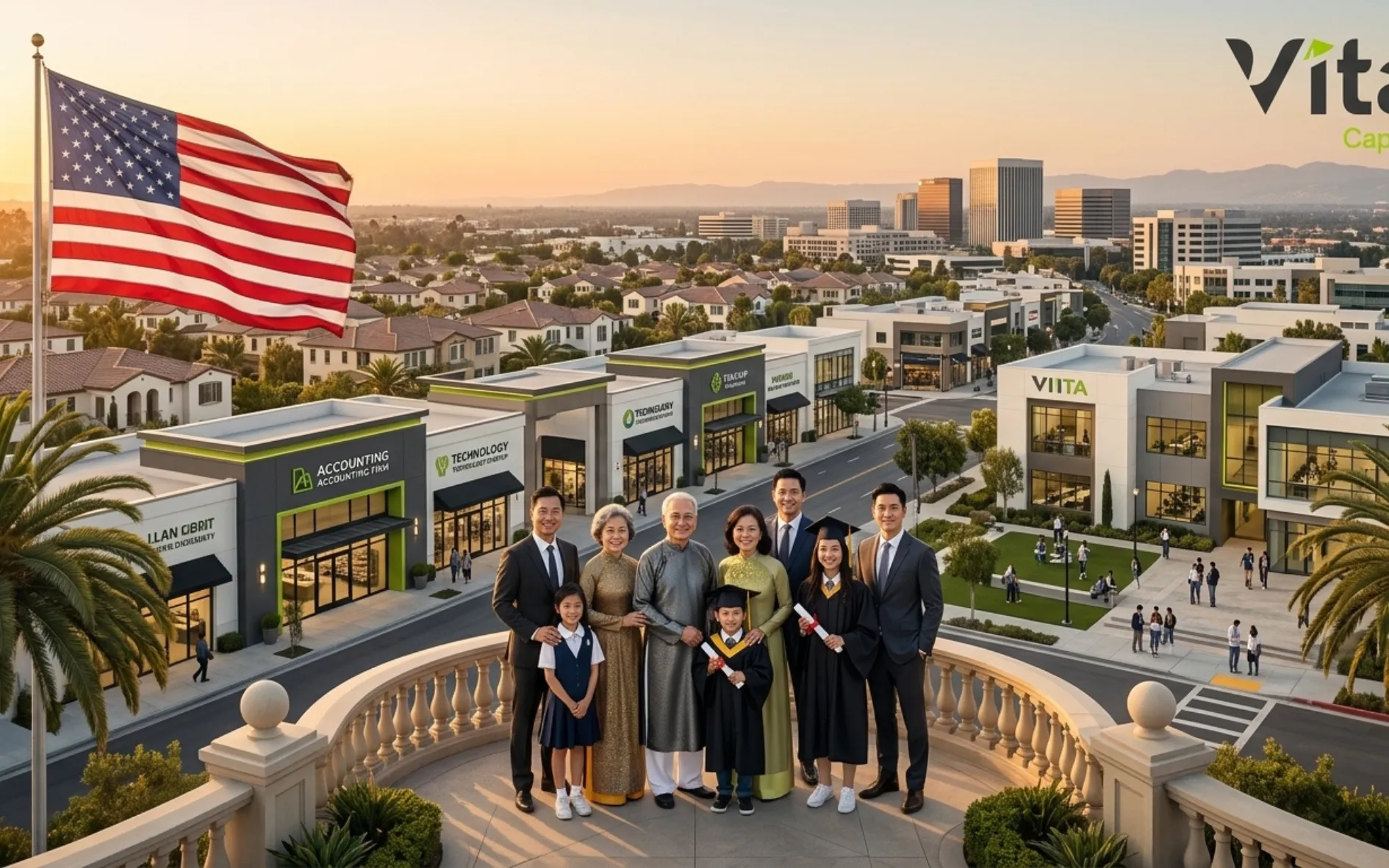
California, especially Orange County with Little Saigon, is the first destination that comes to mind for most Vietnamese families when discussing immigration to the United States. But what is life really like for Vietnamese in California in 2026? How much does it cost, how high are the taxes, what does the Vietnamese community in California offer, and what challenges are many families not told about before they arrive? This article provides a comprehensive and honest analysis to help Vietnamese investors make decisions based on reality rather than idealized images.
The Largest Vietnamese Community Outside Vietnam
Vietnamese in California Little Saigon Orange County largest Vietnamese community in the world 2026
This is a fact that every Vietnamese in California is proud of: Little Saigon in Orange County is the largest overseas Vietnamese community in the world.
Little Saigon is a Vietnamese American residential and commercial district in Orange County, California. The Associated Press and historian Phuong Nguyen have described it as the “cultural capital of the overseas Vietnamese community.” This community forms the largest overseas Vietnamese population in the world, with nearly 242,000 people of Vietnamese descent in Orange County according to the 2020 Census, approximately 200,000 of whom live in the Little Saigon area, accounting for around 10% of the total Vietnamese American population nationwide.
Little Saigon is concentrated primarily in Westminster and Garden Grove, approximately 72 km south of Los Angeles. The commercial district spans more than 3 square miles and includes over 4,000 businesses, including 280 Vietnamese restaurants, Asian supermarkets, bánh mì shops, Vietnamese-speaking medical clinics, Vietnamese law offices, Vietnamese language schools, and hundreds of other community services. Pho, bánh mì, bún bò Huế, chè, and Vietnamese iced coffee can be found on nearly every street corner.
Beyond Orange County, the Vietnamese community in California is also significantly concentrated in:
San Jose (Silicon Valley): A high-tech economic center with the second-largest Vietnamese community in California.
Los Angeles (San Gabriel Valley, Rosemead): Diverse career opportunities and proximity to major commercial centers.
Sacramento: California’s capital city with a stable middle-class Vietnamese community.
San Diego: A growing Vietnamese community near the Mexican border with an ideal climate.
From a cultural and community perspective, California and especially the experience of Vietnamese living in California in Orange County is unlike anywhere else in the United States. This is an undeniable reason why California remains the number one choice despite having the highest costs.
(See also: Top Cities for Vietnamese Investors to Live In)
California Living Costs in 2026: The Reality That Shocks Many Vietnamese Families
This is the section that Vietnamese investors should read most carefully before deciding to settle in California. What is the California cost of living in 2026?
The average cost of living in California in 2026 is $3,514 per month for a single person and $7,739 per month for a family of four, 42% higher than the national average. Housing costs in California are 97% higher than the national average, averaging $2,364 per month for a single person and $4,334 per month for a family.
Housing Costs: The Biggest Barrier
The median home price in California in early 2026 is around $800,000 statewide. In the San Francisco Bay Area and coastal Southern California regions, median home prices comfortably exceed $1 million. Meanwhile, inland areas such as Fresno, Bakersfield, and the Inland Empire offer more affordable options, with average prices ranging from $400,000–$550,000.
Specifically in areas commonly chosen by Vietnamese families:
The median home price in Orange County, home to the largest Vietnamese community in California, reached $1,388,000 in 2024, 1.6 times higher than the California statewide average of $867,000. The total cost of living for a family of three in Orange County is approximately $10,500 per month ($126,100 per year), 16% higher than the California average.
In San Jose (Silicon Valley), home to California’s second-largest Vietnamese community, the cost of living for a family of four is $9,935 per month, 82% higher than the U.S. national average.
Rental prices in popular Vietnamese areas (Q1 2026):
Area
1BR Rent
3BR Rent
Median Home Price
Westminster/Garden Grove (Little Saigon)
$1,800–$2,400
$2,800–$3,800
$900K–$1.2M
San Jose (Evergreen, Alum Rock)
$2,200–$3,000
$3,200–$4,500
$1.1M–$1.4M
Los Angeles (San Gabriel Valley)
$1,900–$2,600
$2,800–$3,600
$800K–$1.1M
Sacramento (Elk Grove)
$1,400–$1,900
$2,000–$2,600
$500K–$650K
As of March 2026, the estimated rent for a two-bedroom home in California is approximately $2,700 per month. Meanwhile, the mortgage payment for a comparable home is about $4,440 per month, 66% higher than renting. This is why many Vietnamese families in California choose to rent rather than buy during their initial years of settlement.
California Taxes: The Highest in America
This is the most important financial factor that many Vietnamese in California are not fully advised about before selecting the state.
California’s state income tax can reach as high as 13.3% for top-income earners under the progressive tax system, making it the highest state personal income tax rate in the United States according to the Tax Foundation. Most middle- to upper-middle-income earners face rates between 9.3% and 10.3%.
The Real Impact of California Taxes on EB-5 Investors
If you have income transferred from Vietnam (business earnings, rental properties, dividends, etc.) and are living in California as a green card holder, that income is subject to both federal tax and California state tax (up to 13.3%). Compared to Texas or Florida (0% state income tax), a California resident earning $200,000 annually from Vietnam would pay an additional $18,000–$26,000 per year in state taxes, equivalent to more than 450–650 million VND annually.
Other taxes in California include:
Sales tax: 7.25% base rate plus local taxes, averaging 8.68–10.25% depending on location.
Gasoline: The average gas price in California in spring 2026 is approximately $5.20 per gallon, compared to the national average of $3.50 per gallon. This is due to high fuel taxes and California’s special fuel-blending requirements.
Vehicle registration fees: Significantly higher than the national average.
Are you considering settling in California or in tax-free states such as Texas or Florida? Contact VITA CAPITAL for a free consultation comparing the financial advantages and disadvantages of each state based on your family’s specific income profile.
Daily Life of Vietnamese in California: A Realistic Perspective
Life of Vietnamese in California Little Saigon Vietnamese living in California daily activities 2026
A Vietnamese Cultural Ecosystem in Little Saigon Unlike Anywhere Else
What makes California, and especially Orange County, uniquely irreplaceable for many Vietnamese families is the completeness of its Vietnamese cultural ecosystem.
Cuisine: More than 280 Vietnamese restaurants in the Little Saigon area alone offer everything from pho, bún bò Huế, cơm tấm, and bánh mì to hot pot and seafood. Supermarkets such as ABC Market, 99 Ranch, and Hong Kong Supermarket provide a full range of Vietnamese cooking ingredients, from water spinach and rice paddy herb to shrimp paste and Hảo Hảo noodles. Many Vietnamese families living in Orange County share that they never feel deprived of Vietnamese food in their daily lives.
Comprehensive Vietnamese-language services: Vietnamese-speaking doctors, Vietnamese lawyers, Vietnamese accountants, Vietnamese real estate agents, and banks with Vietnamese-speaking staff make the process of settling into life in Orange County much faster than in many other states thanks to this complete service ecosystem.
Vietnamese language education: Numerous weekend Vietnamese language schools, Vietnamese Buddhist schools, Vietnamese Catholic churches, and cultural organizations help children of Vietnamese families maintain their connection to their cultural roots.
The Vietnamese community in Little Saigon has grown faster than the overall growth rate of Orange County for decades, driven by continuous immigration from Southeast Asia. It is considered a community that will continue expanding and thriving in the future.
Real Challenges of Vietnamese Living in California
This article would not be honest if it only discussed the positives. Below are the real challenges many Vietnamese in California are facing:
Housing affordability crisis: High home prices and mortgage interest rates in California in 2026 have made homeownership out of reach for many middle-income families. Fewer California households can qualify to buy a home today than before 2020, even though home prices have stabilized since 2022. Many first-generation Vietnamese families arrive in California with the dream of “buying a home in Little Saigon” but end up renting for many years because prices exceed their financial capacity.
Traffic and pollution: Los Angeles and Orange County are notorious for severe traffic congestion. Commutes of one to two hours each way are not uncommon. Air quality in many inland California regions ranks among the worst in the United States.
Rising cost pressures over time: California has the highest electricity costs in the nation due to energy policies, high auto insurance costs, and expensive childcare. Many newly settled Vietnamese families in California report that after two to three years, they realize that the actual quality of life does not match the high costs and begin considering relocation to Texas or Arizona.
Migration out of California: This is a notable trend. Many American families, including Vietnamese families, are moving from California to Texas, Florida, and Arizona in search of lower living costs and lighter tax burdens. Net migration income flows into Florida and Texas have remained strong for years, partly driven by residents leaving California, reflecting a major shift in the U.S. population structure.
Detailed Living Costs for a Family of Four in Orange County in 2026
Below is a realistic monthly budget for a family of four (two adults and two children in K–12 schools) living in the Little Saigon / Westminster area:
Category
Monthly Cost
Notes
3BR rental in Westminster
$2,800–$3,600
Or mortgage payments on a $1M+ home
Food (Vietnamese supermarkets + mostly home cooking)
$800–$1,100
Savings due to Asian supermarkets
Healthcare & insurance
$900–$1,500
Employer plan or ACA marketplace
Transportation (2 gasoline vehicles)
$1,400–$1,900
California vehicle registration fees are high
Electricity, water, internet, phone
$500–$700
California electricity is the most expensive in the U.S.
Entertainment, dining out, travel
$600–$1,000
Little Saigon helps reduce dining costs
Personal expenses, clothing
$400–$600
California taxes (based on income)
Additional 9.3–13.3% of income
Compared with 0% in TX and FL
Equivalent in VND
Approximately 193–275 million VND/month
Comparison: The same lifestyle in Houston, Texas would cost only about $5,000–$7,000 per month, saving $2,000–$4,000 monthly, or $24,000–$48,000 annually, excluding differences in state taxes.
See also: How Much Wealth Does a Vietnamese Family Need to Live in the United States?
California or Texas: The Real Financial Equation for EB-5 Investors
This is a question many Vietnamese families struggle with, and this article will answer it honestly using real-world data.
If your priority is the Vietnamese cultural community and rapid adaptation → California (Orange County) remains number one. Nowhere else in America offers such a complete Vietnamese community ecosystem, from cuisine and language to culture, business networks, and social support systems.
If your priority is long-term financial optimization → Texas or Florida clearly have the advantage. Texas, Florida, Tennessee, and North Carolina combine zero state income tax, competitive corporate taxes, business-friendly regulations, and state economic development offices that support foreign investment, creating one of the most favorable business environments in America for international investors.
A Combined Strategy Successfully Used by Many Vietnamese Families
Many Vietnamese families have successfully adopted the following strategy:
Initially settle in Orange County to establish stability and take advantage of the Vietnamese community (2–3 years), then relocate to Texas or Florida once they have built their own network. This allows them to reduce taxes and living costs while maintaining connections with the Vietnamese community in California through regular visits.
See also: U.S. Taxes for New Immigrants
VITA CAPITAL Accompanies Vietnamese Families from EB-5 to a Stable Life in California
With more than 200,000 Vietnamese in California concentrated in Orange County and Silicon Valley, California remains the top destination for many Vietnamese families, and VITA CAPITAL understands both the reasons behind this choice and the challenges that come with it.
VITA CAPITAL – Your Global Future provides comprehensive support: from EB-5 Rural TEA applications to obtain a green card in approximately three years, to strategic consulting on selecting the most suitable city and state based on each family’s financial goals and lifestyle preferences. The VITA CAPITAL advisory team has practical experience working with the Vietnamese community in California as well as Vietnamese communities in Texas and Florida, helping investors make fully informed decisions rather than relying on idealized perceptions.
Partners including Toppins Law Firm, P.C. (30+ years of experience) and FirstPathway Partners (FPP) (100% success rate) ensure that the EB-5 journey proceeds smoothly so that by the time your family arrives in California or any city in the United States all legal foundations have already been carefully prepared.
California or Texas? Orange County or Houston? The right answer depends on each family’s financial profile, lifestyle, and long-term objectives. There is no universal formula that works for everyone. VITA CAPITAL provides personalized settlement location consulting alongside your EB-5 application before the September 30, 2026 deadline closes. Contact us today for a free consultation.