A US visa interview typically lasts less than three minutes, yet the consular officer’s decision during those three minutes can affect the entire plan of you and your family. In reality, the US Consulate in Vietnam is considered one of the strictest visa-processing offices in Southeast Asia due to high rates of visa overstays and fraudulent applications in the past. However, obtaining a US visa is not a matter of luck. If you prepare your documents correctly, answer honestly, and communicate clearly, approval can absolutely be achieved. Every year, tens of thousands of Vietnamese applicants successfully obtain US visas. This article compiles comprehensive real-world experience: on-site procedures, documents you should bring, the most common US visa interview questions, and the correct ways to answer for different visa categories.
Overview of the US Visa Interview Process in Vietnam 2026
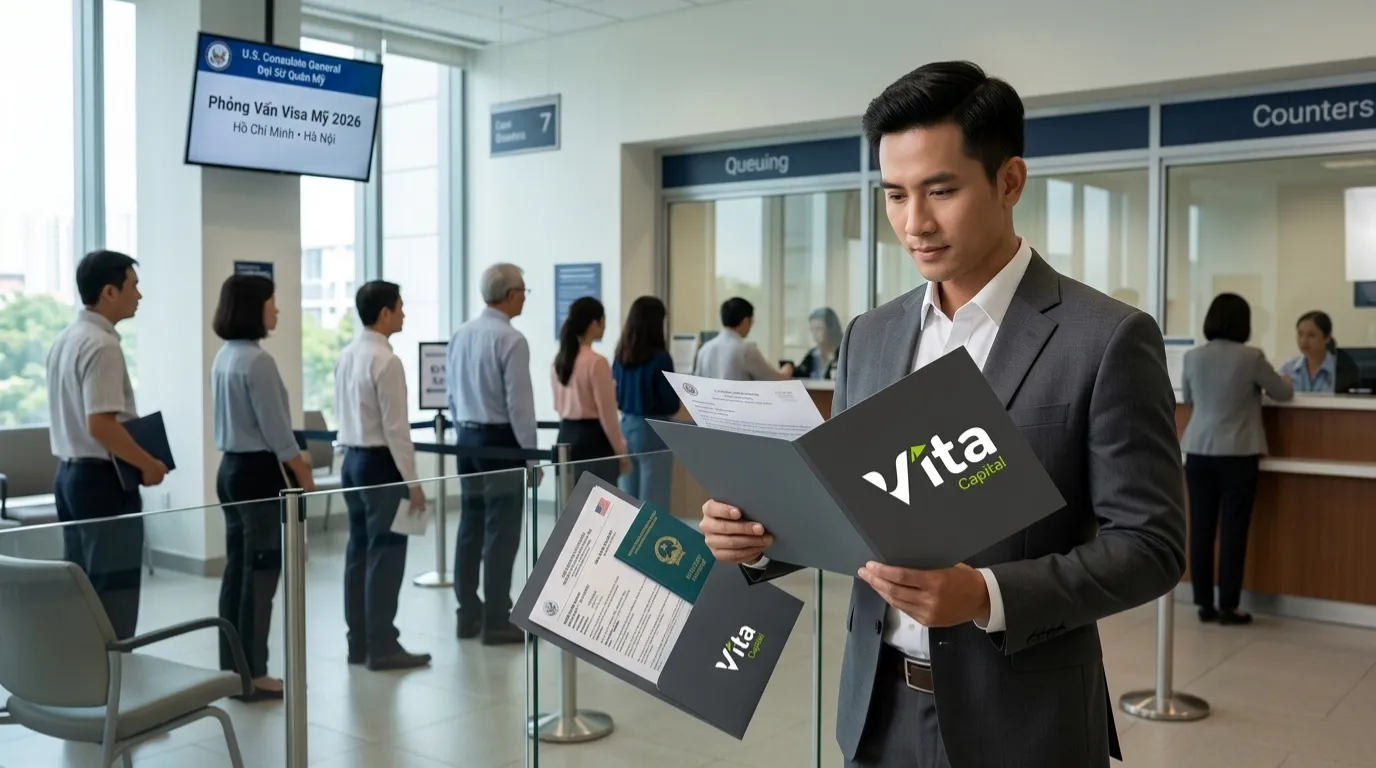
US visa interview process at the US Consulate in Ho Chi Minh City and the US Embassy in Hanoi 2026
Before discussing interview content, it is important to understand the entire on-site process so that nothing catches you by surprise on the appointment day.
Interview Locations and Appointments
US visa interviews in Vietnam are conducted at two locations: the US Consulate General in Ho Chi Minh City (4 Le Duan Boulevard, District 1) and the US Embassy in Hanoi (7 Lang Ha Street, Ba Dinh District). Appointments are scheduled through the usvisa-info.com system. An important note: beginning May 4, 2026, the Consulate will refuse any applicant who has not registered an appointment in the online visa system at least five days before the interview date.
Step-by-Step Interview Procedure
Upon arrival, the process generally follows this order:
Step 1: Security Screening and Initial Document Check Submit your passport, DS-160 confirmation page, and fee payment receipt. Mobile phones are not allowed inside, so leave them outside or power them off completely.
Step 2: Fingerprint Collection A consular officer may verify any one fingerprint during application processing. This is a routine procedure and not a negative sign.
Step 3: Interview at the Consular Window this is the decisive step. An American consular officer will conduct the interview in Vietnamese through an interpreter or directly in English if your visa category requires English proficiency (for example, an F-1 visa indicating English fluency). Average interview time: 2–5 minutes.
Step 4: Immediate Result
Approved: The officer keeps your passport and issues a receipt. You then visit the EMS counter to register a delivery address and pay a 30,000 VND delivery fee. Your visa is typically returned within 2–3 business days.
Denied: The officer returns your passport together with a “blue sheet” explaining the reason for refusal. Do not argue or dispute the decision. Accept it and carefully review the reasons before reapplying.
Administrative Processing (221g): Sometimes the officer issues a temporary refusal to review additional documents or conduct administrative processing. You will receive a letter requesting supplementary documentation. Applicants have one year to submit the requested materials according to the instructions provided. This is not a permanent denial.
Read More: Common US Visa Types for Vietnamese Applicants VITA CAPITAL
Preparing for a US Visa Interview: Documents and Mindset
Bring the Right Documents No More, No Less
To avoid delays, only bring documents required for the interview. Do not overload your application file with unnecessary paperwork. Bring all required documents, organized in order and easy to access when requested.
Mandatory Documents for All Visa Types
Original passport valid for at least six months beyond your intended departure date from the United States
DS-160 confirmation page containing the barcode after completing the online application
US-standard passport photo: 5×5 cm, white background, taken within the last six months
MRV fee payment receipt of USD 185
SEVIS fee payment receipt (for F-1, J-1, and M-1 visas)
Additional Documents by Visa Type
Visa Type
Most Important Supporting Documents
B1/B2
Bank statements for the last 3–6 months, employment contract, leave approval letter, property ownership documents
F-1
Form I-20, admission letter, transcripts, IELTS/TOEFL scores, proof of sufficient financial resources for the entire program
H-1B
Form I-797 (approval notice), employment contract with the US employer
L-1
Form I-797, employment contract with the parent company, confirmation of position at the US company
EB-5
Approved Form I-526E, investment documentation, Regional Center confirmation
Golden Financial Rule: A savings account or bank balance confirmation should ideally show at least VND 200 million. More importantly, the balance must be stable and should not include a large deposit made shortly before the interview date. This is the number-one red flag and is often detected immediately.
Mental Preparation Before the Interview
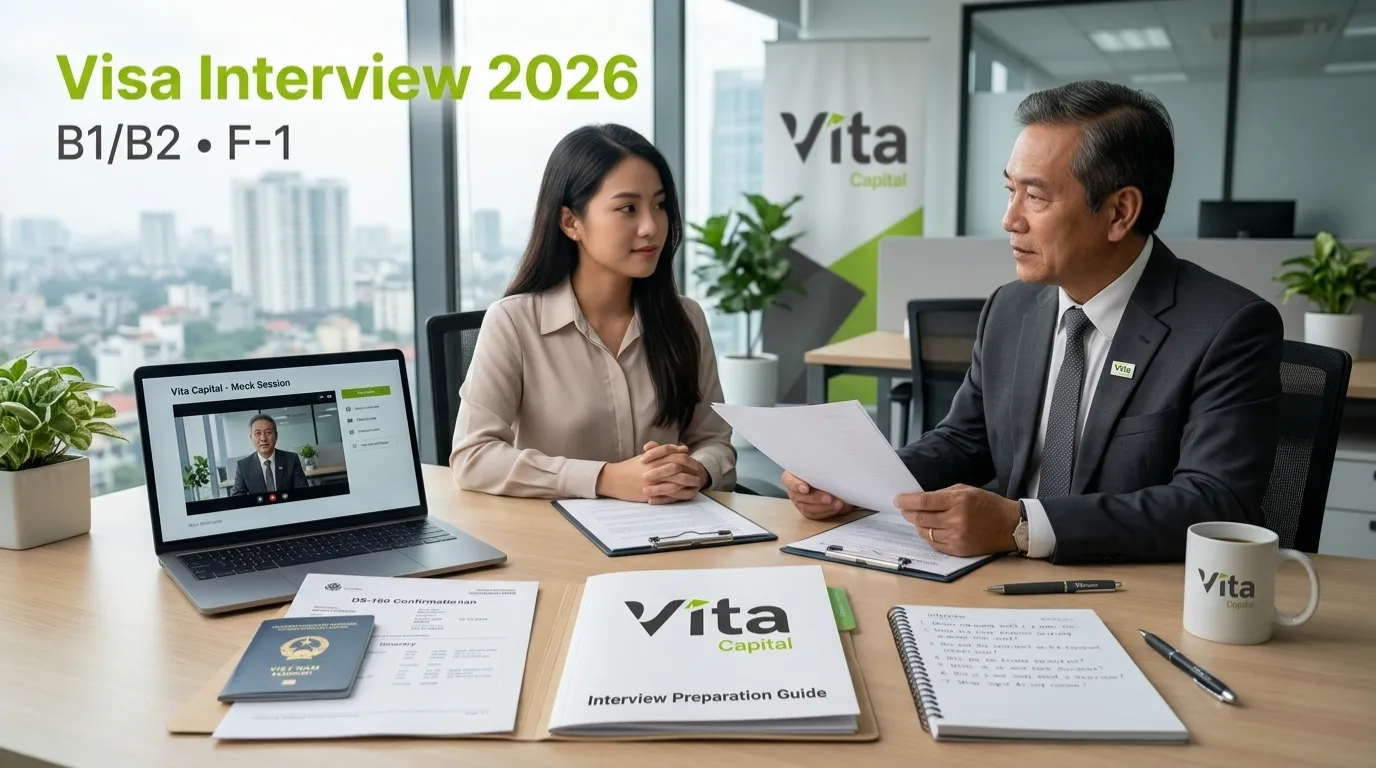
Arrive at least 15 minutes early to settle yourself. Arriving exactly on time can create unnecessary stress due to rushing. Regarding attire: dress neatly and professionally. Business-casual clothing is ideal. There is no need for overly formal attire, but shorts, flip-flops, and inappropriate clothing should be avoided.
Most importantly, there is no answer trick that guarantees a 100% approval rate. The only effective principle is to get straight to the point and avoid rambling. Short, clear answers that are consistent with your DS-160 are always better than lengthy but vague responses.
Common US Visa Interview Questions and the Correct Ways to Answer
Common US visa interview questions 2026 B1 B2 F1 answer guide
General Questions for All Visa Types
These questions appear in nearly every US visa interview regardless of visa category.
“What is the purpose of your trip?” Answer directly, specifically, and consistently with your DS-160.
Example:
"I am traveling for tourism. I will visit New York and Los Angeles for 15 days and then return to Vietnam to continue my work."
Never say:
"Just traveling around." Too vague.
"I’ll decide when I get there." Immediate red flag.
“What do you do for a living, and what is your income?” Answer consistently with the employment information in your application. If you own a business, describe the industry and scale of operations. You may add: "I have an approved leave request from my employer for this trip."
“Do you have relatives in the United States?” This is one of the most important risk-assessment questions for Vietnamese applicants. If you have relatives in the US, the officer will ask more detailed questions to determine whether you intend to remain in the country. Be prepared to explain the relationship clearly and why you will return to Vietnam after your trip.
Never conceal this information. If the officer discovers that you lied about even one detail, your entire application may lose credibility.
“Why will you return to Vietnam?” This is the core question behind the entire interview process. Everything in your application is intended to answer this question.
The strongest answer includes all three elements:
Stable employment and income
Assets or financial ties
Family members or responsibilities in Vietnam
Questions Specific to B1/B2 Tourist and Business Visas
“Do you have a specific itinerary?”
You should be able to explain:
Which cities you will visit
Where you will stay (hotel names)
How many days you will spend there
What activities you plan to do
You do not need to book hotels before the interview, but you should have a clear travel plan. If you already have hotel reservations, bringing confirmation documents is a significant advantage.
“Who is paying for your trip?”
If you are funding the trip yourself, your financial statements must demonstrate sufficient resources.
If someone is sponsoring your trip, you should provide a sponsorship letter along with the sponsor’s financial documentation.
Avoid vague answers such as:
"My family will support me."
without any supporting documentation.
“Have you traveled abroad before?”
A strong travel history traveling internationally and returning on time—is a considerable advantage.
If you have never traveled abroad, your financial profile and ties to Vietnam should be stronger than average to compensate.
Questions Specific to F-1 Student Visas
“Why did you choose this school?”
Your answer should be specific and focused on:
Academic programs
School ranking
Major and career relevance
Do not simply say:
"Because it is a famous school."
If your I-20 indicates English proficiency, the consular officer may conduct the interview in English. You cannot claim strong English skills while struggling to answer basic questions.
“What will you do after graduation?”
The ideal answer is:
"I plan to return to Vietnam and apply the knowledge I gain to [specific career or industry-related reasons]."
Avoid statements that imply you intend to remain permanently in the United States, even if that is your actual long-term plan.
“Who will pay for your education?”
Your answer must match the financial documentation submitted.
If your parents are sponsoring your education, be prepared to explain:
Their source of income
Their financial capacity
Why they can afford the entire cost of your education
Questions Specific to L-1 Intracompany Transfer Visas
“What is the legal relationship between your company in Vietnam and the company in the United States?”
You should clearly explain:
Ownership structure
Shareholding percentages
Parent-subsidiary relationship or branch structure
For L-1 visas, emphasize:
Your executive or managerial role
Specialized knowledge
At least one year of employment with the parent company during the previous three years
“What exactly will you do at the US office?”
Avoid vague answers such as:
"The company will decide after I arrive."
This type of response often leads to denial.
Instead, clearly describe:
Your responsibilities
Decision-making authority
Number of employees you will supervise
Read More: From Studying Abroad to US Permanent Residency: The Complete 2026 Roadmap VITA CAPITAL
Note from VITA CAPITAL: For immigrant visa categories such as EB-5, L-1A, and other immigrant pathways, the US visa interview process is significantly more complex than B1/B2 or F-1 interviews. Errors at this stage can result in delays lasting years. This is when experienced immigration attorneys become essential, not just general consultants. Contact VITA CAPITAL for in-depth guidance at tuvandimy.com.
Common Mistakes That Cause Vietnamese Applicants to Fail US Visa Interviews
Analysis of refusal data from the US Consulate in Ho Chi Minh City and the US Embassy in Hanoi shows that most denials fall into one of the following categories.
Mistake 1: Failure to Demonstrate Strong Ties to Vietnam
This is the most common reason for denial under Section 214(b) of US immigration law.
Refusals under this section accounted for more than 30% of all B1/B2 visa denials in 2025.
The weakest applicant profiles often include:
Young and single individuals
No significant assets
No stable employment
No dependents or family responsibilities in Vietnam
Solution: Build strong ties well before applying. Do not wait until the last minute to strengthen your case.
Mistake 2: Inconsistent Financial Evidence
Making a large deposit one or two weeks before the interview is one of the first warning signs that consular officers notice.
Insufficient financial resources or an inability to explain the source of funds accounts for approximately 20% of visa refusals.
Bank statements should demonstrate:
Stability
Consistent income
Genuine assets
for at least 3–6 consecutive months.
Mistake 3: Answers That Do Not Match the DS-160
The consular officer reviews your DS-160 throughout the interview and asks questions based on the information you provided.
If your verbal answers differ from your application—even regarding minor details such as:
Employer name
Job title
Address
it immediately raises concerns.
Review your DS-160 carefully at least 3–5 days before the interview.
Mistake 4: Memorized and Robotic Answers
Consular officers can easily recognize rehearsed responses. They may ask an unexpected follow-up question to verify authenticity. You only need to understand the key points. Use natural language rather than reciting a script. Applicants who appear nervous but genuine often have a higher approval rate than those delivering polished but obviously memorized responses.
Mistake 5: Missing Documents or Technical Errors
Incomplete documentation or inconsistent information among supporting documents can result in a temporary refusal under Section 221(g).
This causes delays and may require additional appointments.
Double-check:
Passport name matches DS-160
Date of birth is correct
Addresses are consistent across all documents
Mistake 6: Arriving Late or Failing to Register on Time
Although technical in nature, this mistake can have serious consequences.
Beginning May 4, 2026, applicants who fail to register their interview appointment at least five days in advance through the online system may be denied entry at the gate. They must schedule a new appointment, wait for availability, and postpone their entire plan.
US Visa Interviews for Applicants Planning Long-Term Immigration
One final point that many people overlook:
Your US visa interview strategy should align with your family's long-term objectives. If your actual goal is to immigrate to the United States within the next three to five years, applying for a B1/B2 or F-1 visa may still be the correct short-term approach. However, you should simultaneously prepare an immigration application under the appropriate category (EB-5, EB-3, L-1, etc.) to avoid future legal complications such as:
The J-1 two-year home residency requirement
Being flagged for immigrant intent in your immigration history
Families with long-term immigration goals need comprehensive strategic planning rather than advice on individual visa categories alone.
VITA CAPITAL: Comprehensive US Visa and Immigration Consulting for Vietnamese Families
A successful US visa interview does not begin the day before your appointment.
It begins with:
Building the right application profile
Choosing the correct visa category
Creating a roadmap aligned with your family's real goals
VITA CAPITAL provides comprehensive consulting for both journeys:
Short-term visa interview preparation
Long-term US immigration planning
Important Deadline Reminder
The EB-5 Program is currently operating under the existing investment threshold with a deadline of September 30, 2026.
After that, the minimum investment amount is expected to increase beginning in January 2027. From obtaining your first US visa for travel to securing permanent residency for your entire family, VITA CAPITAL provides comprehensive, structured, and transparent legal solutions. Do not let the September 30, 2026 deadline pass without a clear immigration roadmap.