Most Vietnamese families begin researching the cost of studying in the USA with a vague estimate of “a few billion VND,” only to be shocked when they see the actual breakdown. Not because America is prohibitively expensive, but because there are many costs that educational consulting websites often overlook: SEVIS fees, mandatory health insurance, real housing costs in different cities, first-year setup expenses, and most importantly, strategies to reduce costs through financial aid for international students and scholarships in the USA for Vietnamese students.
This article provides a comprehensive overview of every expense, from the moment you submit applications until graduation.
Overview of the Cost of Studying in the USA 2026: Real Numbers Before Scholarships
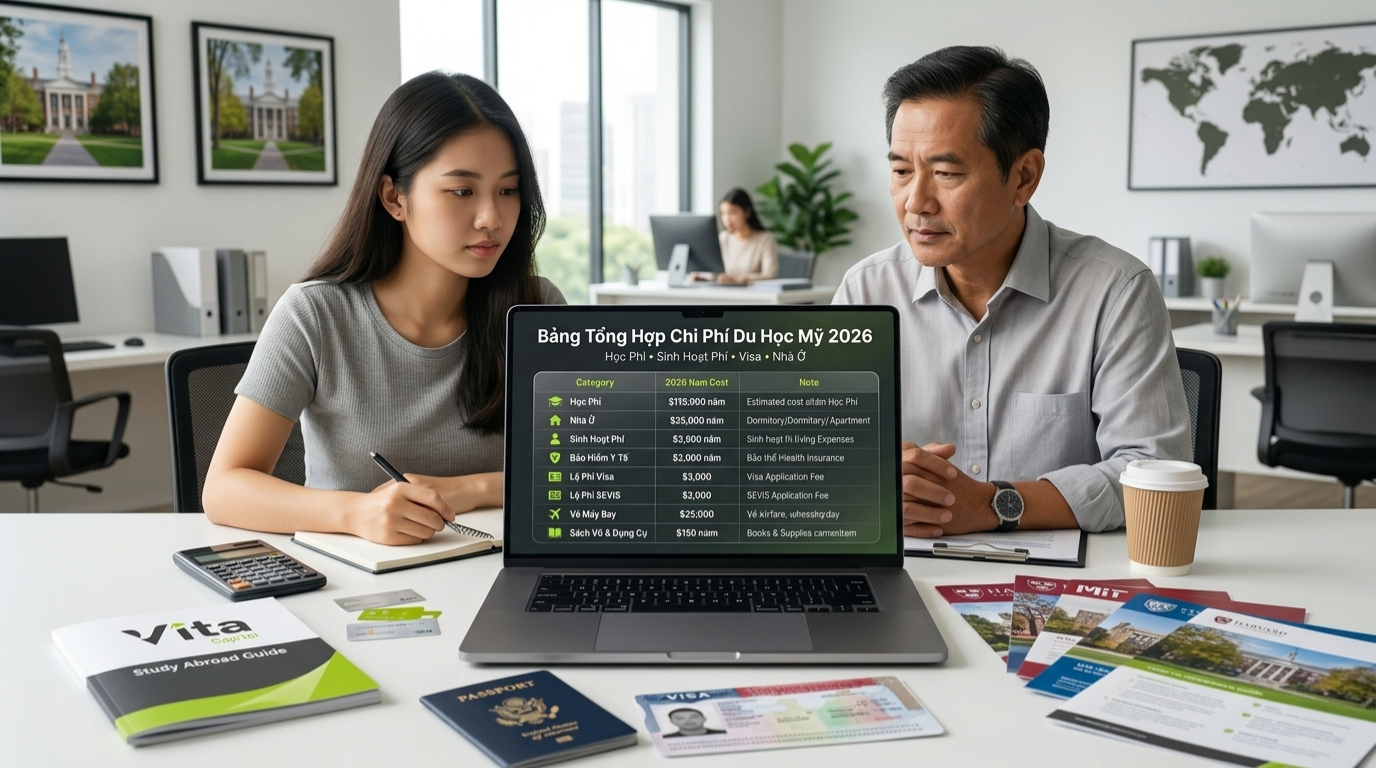
Summary table of cost of studying in the USA 2026 tuition living expenses visa fees
Before diving into individual expenses, here is the overall framework families should understand:
When tuition, housing, and living expenses are combined, international students in the United States should budget between $32,000 and $60,000 per year. Highly ranked private universities in major cities typically fall at the upper end of this range.
The average total cost of a four-year bachelor’s degree in the United States for international students can range from $100,000 to $300,000, depending on the institution type, major, and location.
Type of Institution
Tuition per Year (USD)
Total Annual Cost (USD)
Estimated 4-Year Cost
Public University (Out-of-State)
20,000–35,000
32,000–50,000
128,000–200,000
Mid-Tier Private University
35,000–50,000
50,000–65,000
200,000–260,000
Elite Private University (Ivy/Top Tier)
55,000–75,000
70,000–90,000
280,000–360,000+
These figures are before scholarships and financial aid are applied, an extremely important point that will be discussed later, as actual costs after aid can sometimes be reduced by 50–70%.
See also: Top Universities in the USA Worth Considering in 2026 VITA CAPITAL
Detailed Breakdown of the Cost of Studying in the USA
Tuition: The Largest Yet Most Variable Expense
For the 2025–2026 academic year, average tuition at U.S. public universities is approximately $11,371 per year for in-state students and $25,415 per year for out-of-state and international students. At private universities, the average rises to $44,961 per year.
However, at prestigious top universities in the USA, actual tuition is significantly higher. International students at leading private institutions may pay between $50,000 and $80,000 per year in tuition alone. Housing and living expenses are not included in these figures.
Important note: Tuition typically increases by 3–5% annually. When estimating the cost of studying in the USA for 4 years, families should factor this increase into their long-term financial planning.
Living Expenses: The Most Underestimated Cost
Monthly living expenses in the United States generally range from $1,200 to $2,500, depending on the city. Major metropolitan areas such as New York and San Francisco can exceed these estimates.
Below is a comparison of living costs by location an important factor many Vietnamese students overlook when choosing a university:
City
Housing/Month (USD)
Food/Month (USD)
Transportation/Month (USD)
Estimated Total/Month
New York, NY
1,200–2,000
400–600
130
1,800–2,800
Boston, MA
1,000–1,800
350–500
100
1,500–2,400
Los Angeles, CA
1,000–1,700
350–500
150
1,600–2,400
Chicago, IL
800–1,400
300–450
110
1,300–2,000
Austin, TX
700–1,200
280–400
80
1,100–1,700
Small College Towns (Average)
500–900
250–380
60
900–1,400
Off-campus housing typically costs between $500 and $1,200 per month, while utilities and internet may add another $100–200 monthly.
For students living on campus, meal plans generally range from $2,000 to $5,000 per academic year.
Health Insurance: Mandatory but Frequently Overlooked
Many Vietnamese students only discover this expense after arriving in the United States.
Most U.S. universities require international students to maintain health insurance, often bundled into tuition under a Student Health Insurance Fee, which typically ranges from $1,500 to $3,500 per year depending on the institution and coverage plan.
While students may sometimes purchase external insurance, they must prove it meets the university’s minimum requirements a process that is often complicated and not significantly cheaper.
Textbooks and Academic Supplies
The average annual cost of textbooks and academic supplies ranges from $500 to $1,000, depending on the institution and field of study.
Students in Medicine, Law, and Engineering often spend considerably more.
A practical tip: purchasing used textbooks through AbeBooks or Amazon, or borrowing from university libraries, can reduce these costs by 60–70%.
F-1 Student Visa Costs and Pre-Departure Expenses
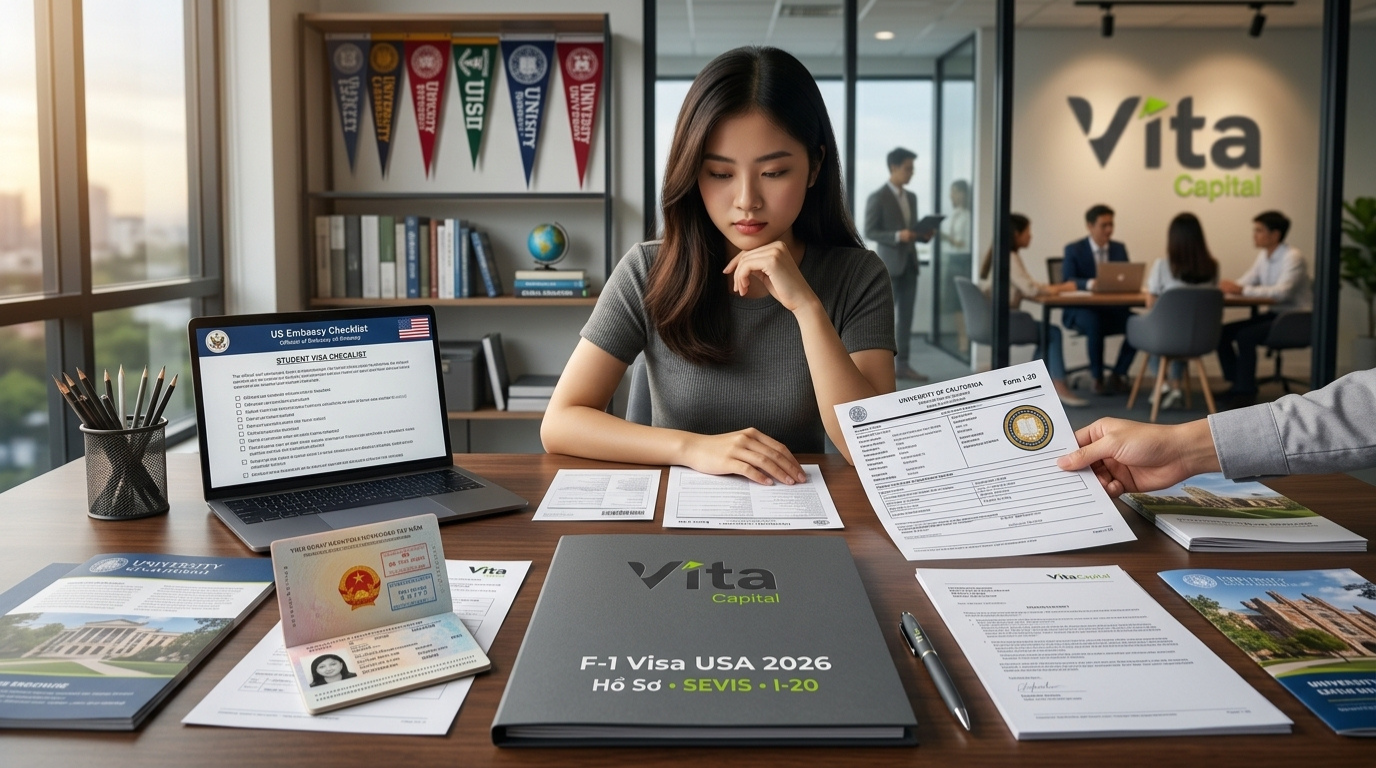
F-1 student visa process USA 2026 SEVIS fee application documents
These are one-time expenses that occur before students board their flight, but together they can be substantial and should be budgeted carefully.
Mandatory F-1 Student Visa Fees in 2026
As of February 2026, the SEVIS I-901 fee for an F-1 student visa is $350. This fee is associated with the SEVIS ID listed on Form I-20 and must be paid before the visa interview.
The separate MRV visa application fee is $185, payable through the U.S. Department of State’s system.
The minimum mandatory cost for obtaining an F-1 student visa is therefore $535, consisting of:
SEVIS Fee: $350
MRV Fee: $185
However, after including additional expenses required by individual schools and circumstances, actual startup costs can range from $600 to $2,000.
Expense
Cost (USD)
Notes
SEVIS I-901 Fee
350
Paid after receiving Form I-20
MRV Visa Application Fee
185
Paid when scheduling interview
Translation & Notarization
50–150
Depends on document volume
Visa Photos & Printing
20–50
Small but necessary expense
Round-Trip Vietnam–USA Airfare
1,000–1,500
Seasonal fluctuations apply
Initial Setup Purchases
500–1,500
Bedding, kitchen supplies, etc.
Total Startup Cost
Approximately 2,100–3,700
Excluding first semester tuition
Important Notes About the F-1 Student Visa in 2026
In 2026, F-1 visa interviews are typically shorter and more direct, often lasting less than two minutes.
Consular officers focus heavily on:
Reliability of financial resources
Clear educational objectives
Consistency between DS-160 information and interview responses
The most common reasons Vietnamese students are denied visas include:
Large unexplained deposits appearing shortly before the interview (the biggest red flag)
Failure to demonstrate intent to return to Vietnam after graduation
Inconsistent answers compared with information provided in the DS-160 application
See also: Legal Investment Transfers to the USA VITA CAPITAL
VITA CAPITAL Insight: For families considering both education and immigration in the United States, optimizing the cost of studying in the USA should be viewed within a broader long-term financial strategy. Free immigration and financial consultations are available at tuvandimy.com.
Scholarships in the USA for Vietnamese Students: How to Truly Reduce the Cost of Studying in the USA for 4 Years
This is arguably the most important and most overlooked section.
Every year, billions of dollars in scholarships and financial aid for international students are distributed by U.S. universities. Yet only around 30% of eligible applicants submit complete and timely applications, meaning a significant portion of available funding goes unused.
Category 1: Need-Based Financial Aid Less Known but Highest Value
Harvard meets 100% of demonstrated financial need without requiring repayment, and international students receive equal treatment under this policy.
Stanford provides full tuition coverage for families earning less than $150,000 annually. Princeton offers grants rather than student loans, meaning aid does not need to be repaid. This explains why the actual cost of studying in the USA at Harvard can sometimes be lower than attending a less prestigious institution with weaker aid programs.
Families should note that international students generally submit the CSS Profile, not FAFSA, when applying for institutional aid.
Category 2: Merit-Based Scholarships
Merit-based scholarships are awarded based on academic performance and personal achievements. Award values typically range from 30% to 100% of tuition, depending on institutional policies. These are often the most accessible scholarships in the USA for Vietnamese students, since eligibility depends on academic and extracurricular strength rather than family income.
Competitive benchmarks generally include:
GPA: 8.5/10 or higher (approximately 3.7 U.S. GPA)
IELTS: 7.0+
TOEFL iBT: 100+
SAT: 1300+ (if required)
Category 3: U.S. Government Scholarships for Vietnamese Students
Fulbright Vietnam
A fully funded scholarship sponsored by the U.S. government, covering:
Tuition
Living expenses
Health insurance
Round-trip airfare
Available for Master’s and PhD programs.
Requirements include:
Vietnamese citizenship
Bachelor’s degree
Minimum two years of work experience
TOEFL iBT ≥ 79 or IELTS ≥ 6.5
Priority fields include public policy, education, environmental studies, and communications. MBA programs and clinical medical studies are generally not funded.
Humphrey Fellowship Program
Designed for experienced professionals and emerging leaders.
The program does not grant a degree but focuses on professional exchange, seminars, and specialized training in the United States over approximately ten months.
Summary: Real Costs After Financial Aid
These figures illustrate why the actual cost of studying in the USA for 4 years can vary dramatically depending on school selection strategy and application preparation.
Studying in the United States is not exclusively for wealthy families. Success often depends more on understanding financial aid systems and preparing a strong application than on family income alone.
See also: How Much Wealth Does a Vietnamese Family Need to Live in the USA? — VITA CAPITAL
Complete Cost of Studying in the USA Budget Checklist
Before Departure (One-Time Costs)
University application fees: $50–100 per school
SEVIS I-901 fee: $350
MRV visa fee: $185
Translation and notarization: $100–300
Round-trip airfare: $1,000–1,500
Initial dormitory and winter clothing purchases: $800–2,000
Annual Expenses (Multiply by Four for a Bachelor’s Degree)
Tuition: based on institution type
Housing: $6,000–24,000 per year
Meal plans or self-catering: $3,500–7,000 per year
Mandatory health insurance: $1,500–3,500 per year
Books and supplies: $500–1,000 per year
Transportation: $600–1,500 per year
Personal expenses: $1,500–3,000 per year
Annual trip home: $1,000–1,500
Additional Expenses to Keep in Reserve
Visa extension or status changes: $370–500
Medical expenses outside insurance coverage: $200–800 annually
OPT application fee after graduation: $410
VITA CAPITAL Supports Vietnamese Families Planning for Long-Term U.S. Immigration
When the total cost of studying in the USA for 4 years can reach $200,000–300,000, many families begin asking a bigger question:
Instead of investing solely in tuition, is there a pathway that allows the entire family to legally settle in the United States while supporting a child’s education and securing a long-term future?
Important Deadline
The EB-5 Investment Immigration Program is currently operating under the existing investment threshold, with a critical deadline of September 30, 2026. After this date, the minimum investment amount is expected to increase beginning in January 2027.
Families considering immigration alongside their child’s educational plans should begin consultations as soon as possible.
From optimizing the cost of studying in the USA to obtaining permanent residency for the entire family, VITA CAPITAL provides comprehensive, structured, and lawful solutions. Do not let the September 30, 2026 deadline pass without a clear plan.